

Checking a Developer in Dubai Before You Buy Off-Plan: Licence Register, Escrow Account, Project Status and Handover Record
To check a Dubai developer, confirm it is listed in the Dubai Land Department (DLD) register of licensed developers, find the project in DLD Project Status Enquiry and make sure every payment goes into the project's escrow account. These three official checks have no fee listed by the DLD, take minutes and show whether the developer may legally sell the units. This guide covers them, the checks the DLD does not do for you and what Dubai law gives buyers if a project stalls. Rules and figures are as of 25 September 2026. The checks matter more in 2026 because the off-plan pipeline is large: according to Cushman & Wakefield Core, as reported by Khaleej Times on 20 August 2026, only about 186,000 of nearly 525,000 planned units had passed 20% construction progress. A brochure, a show apartment and a well-known name do not tell you which of those projects a specific developer will finish on time. The official registers do.
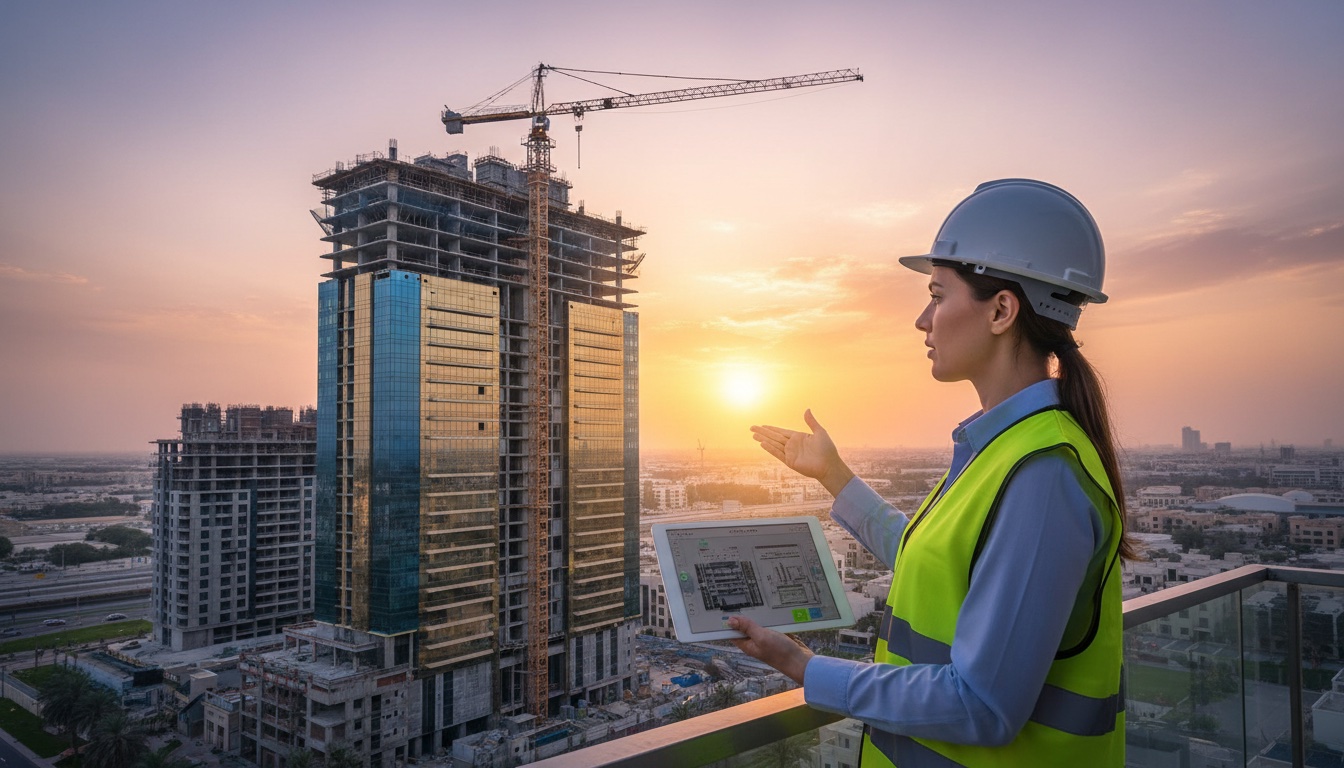
Dubai developer check vs project check: what you are verifying
Checking a Dubai developer and checking an off-plan project are two separate steps, because a licensed developer can still sell a project that is not registered. The Dubai developer check answers one question: is this company allowed to develop and sell real estate in Dubai? The project check answers another: is this specific building registered with the DLD, is it being built, and where does your money go?
Dubai law ties the Dubai developer check and the project check together. Law No. 13 of 2008 on the Interim Real Property Register says that no master developer or sub-developer may sell units off-plan before taking possession of the land and obtaining the required approvals (Article 4). Law No. 8 of 2007 on escrow accounts requires a separate escrow account for each project (Article 9). So a proper check has four parts:
- the company: licence in the DLD register of developers;
- the project: registration, status and completion percentage in the DLD;
- the money: an escrow account in an approved bank, named in the project record;
- your contract: Oqood registration of your unit in the interim register.
The regulator behind these rules is the Real Estate Regulatory Agency (RERA), a public body affiliated to the Dubai Land Department under Law No. 4 of 2019. RERA regulates and monitors escrow accounts and approves the banks allowed to hold them.
Step 1: confirm the Dubai developer is licensed
The DLD Licensed Developers service shows every Dubai developer approved by the Land Department, and a buyer can search it in seconds. The service is public, has no fee listed and is available on dubailand.gov.ae and in the Dubai REST app.
How to use it:
- Open “Licensed Developers” in the DLD e-services or in Dubai REST.
- Search by the company’s legal name, not by the project’s marketing brand.
- Compare the name with the seller named in the sale and purchase agreement (SPA) and on the payment receipts.
The legal name matters. Large Dubai groups sell through several entities, and a project brand often differs from the licensed company. For example, Meraas, Nakheel and Dubai Properties are separate brands within Dubai Holding Real Estate. Whether you are buying from Emaar Properties, DAMAC Properties or a sub-developer you have never heard of, the check is the same: the company that signs your SPA must be in the register.
Under Law No. 8 of 2007 (Article 4), a Dubai developer may not operate unless it is recorded in the Land Department register and licensed. If the seller’s legal name is not in the list, stop and ask why before you pay a reservation deposit.
Anti-fake: a well-known brand is not a registration. A licence belongs to the company, and each project needs its own DLD registration and escrow account.
Step 2: check the off-plan project in DLD Project Status Enquiry
DLD Project Status Enquiry shows an off-plan project’s developer, status, key dates, completion percentage and escrow bank, searchable by project name or number. It is the single most useful check for an off-plan buyer, and it runs on the DLD website, in the Dubai REST app and through the DLD WhatsApp channel.
What to read in the result:
| Field | What it tells you | What to compare it with |
|---|---|---|
| Developer | the company registered for the project | the seller in your SPA |
| Project status | active, completed or another status | the sales pitch |
| Registration, start and completion dates | the official timeline | the handover date in the SPA |
| Completion percentage | construction progress certified for the DLD | the payment plan stage you are asked to pay |
| Escrow bank | the bank holding the project’s escrow account | the account number on your payment instructions |
The table in words: the project record gives you the developer, the timeline, the progress percentage and the bank, and each of them should match your contract and your payment instructions.
The completion percentage is the number to watch on any Dubai off-plan project. If a payment plan asks for 40% of the price while the DLD record shows 5% construction progress, you are paying ahead of the building. That is common in payment plans, but it means more of your money depends on the developer finishing the project.
A project that does not appear in the enquiry at all is a red flag, whoever the Dubai developer behind it is.
Escrow account: how Law No. 8 of 2007 protects off-plan payments
An escrow account in Dubai is a bank account opened in the name of one project, where buyers’ off-plan payments are held and spent only on building that project, not on the Dubai developer’s other business. Article 9 of Law No. 8 of 2007 says the account is “dedicated exclusively to the construction” of the project, and each project must have its own account.
Three rules shape how the money moves:
- Registration first. To register a project for off-plan sale, the DLD requires a title deed for the land and a 30% guarantee: 30% of construction completed, a bank guarantee for 30% of construction, or a cash deposit equal to 30% (DLD “Register Project” service, checked 25 September 2026).
- Payment against progress. The DLD explains that the escrow trustee’s engineer visits the site and confirms that a construction stage is complete before the trustee releases money from the account to pay for the construction works. The DLD service for activating an escrow account links releases to a technical report after 20% completion.
- Retention after completion. Under Article 14, the escrow agent keeps 5% of the total value of the account after the developer obtains the completion certificate and releases it one year after the units are registered in the buyers’ names.
For a buyer in Dubai, the practical rule is simple: pay only into the escrow account named for your project. The DLD publishes the list of approved escrow account trustees, and the Project Status Enquiry shows which bank holds your project’s account. A request to pay a personal account, a broker’s account or a developer’s general company account is a warning sign, whatever the reason given.
Anti-fake: escrow protects the money, not the timeline. The account makes sure payments go into construction; it does not stop a developer from handing over late.
Oqood: registering your off-plan purchase in the interim register
Oqood is the DLD interim register for off-plan sales: the developer registers your unit in it after the sale, and you receive a provisional registration certificate. Under Article 3 of Law No. 13 of 2008, a sale of an off-plan unit that is not entered in the interim register is void.
The developer submits the registration through the Oqood system. The DLD fee is 4% of the price, split in the official tariff into 2% for the seller and 2% for the buyer, plus small administrative fees. After completion, the unit moves to the permanent property register and the owner receives a title deed.
What to check:
- the certificate shows your name, the unit number and the price in your SPA;
- the project name and number match the Project Status Enquiry record;
- the certificate arrives after you pay the Oqood fee; if weeks pass without it, ask the developer for the registration status in writing.
An Oqood certificate also matters later in Dubai: it is the document that shows your off-plan unit is registered in your name, so banks, buyers and service providers usually ask for it when you finance, resell or prove ownership of the unit. Readers planning to finance the purchase can see how banks treat registered off-plan units in our guide to getting a mortgage on an off-plan property in Dubai.
Trakheesi permits and the Madmoun QR code on property ads
Every legal off-plan advertisement by a Dubai developer or broker carries a Land Department permit, and the Madmoun QR code on the ad lets a buyer check the listing, the property and the advertiser in one scan. The DLD introduced the QR code for property advertisements in April 2023.
Article 5 of Law No. 8 of 2007 says a developer may not advertise off-plan units in local or international media, or at exhibitions, without written authorisation from the DLD. Permits for ads and for brokers run through Trakheesi, the DLD licensing system.
How to use it:
- Scan the QR code on the advertisement with your phone camera.
- Check that the permit is valid and that the property, the project and the advertiser match the ad.
- For a broker or agency, use the DLD “Verify License and Permits” service or the list of licensed real estate brokers in Dubai REST.
In Dubai, a permit shows that the advertisement and the advertiser are licensed. It does not confirm the price, the payment plan or the handover date in the ad; those come from the SPA and the Project Status Enquiry.
Track record: how to check a developer’s handover history by dates
A Dubai developer’s track record is the gap between the handover dates it promised and the dates its buildings were actually completed, project by project. Marketing materials list completed projects; they rarely list how late each one was.
A practical method:
- List three to five of the developer’s completed projects from its own website or the projects catalogue.
- Search each project in Project Status Enquiry and note the registration, start and completion dates.
- Compare the completion date with the handover date the developer advertised at launch, from press releases or archived brochures.
- Check whether the developer’s current projects show progress that matches the time since launch.
Look for a pattern, not a single project. In our assessment, one delayed tower in a long portfolio says little; most projects finishing a year or more late says a lot.
The market context makes this step more important. Cushman & Wakefield Core expected about 32,000 units to be delivered in Dubai in the second half of 2026 (MarketBeat, 24 July 2026), and Khaleej Times, citing the DLD, reported 104 projects completed in the first half of 2026. At the same time, only about 186,000 of the nearly 525,000 planned units had passed 20% construction progress (Cushman & Wakefield Core via Khaleej Times, 20 August 2026). The rest of the pipeline is at an early stage, and the developer’s record is the best available guide to how it will perform.
Anti-fake: “completed on schedule” in a brochure is a claim, not a record. The dates in the official project record are the record.
Bank partnerships as an indirect signal of developer quality
In our assessment, a bank partnership is a useful signal of developer quality, though not a guarantee: a bank that finances off-plan units in a developer’s projects has reviewed that developer. In April 2026 Emirates NBD announced two such arrangements.
- Dubai Holding Real Estate. On 16 April 2026 Emirates NBD and Dubai Holding Real Estate introduced off-plan mortgage financing across Meraas, Nakheel and Dubai Properties projects, available to residents and non-residents subject to approval. Gulf News reported that applications are considered once the buyer has paid 50% of the price and construction is 30% complete.
- Sobha Realty. On 8 April 2026 Emirates NBD and Sobha Realty announced a home financing partnership for off-plan units in Sobha developments. The published release does not state the payment or construction thresholds.
Any off-plan mortgage in the UAE is limited by the Central Bank rule that the maximum loan-to-value ratio for property bought off-plan is 50%, regardless of the buyer’s category. A partnership does not change that cap and does not mean every application is approved.
Treat the absence of a bank partnership with care as well. Many developers have no public agreement with a bank, and that alone says nothing bad about them. The signal works in one direction: a partnership adds confidence, and its absence is neutral.
If the project is delayed or cancelled: your rights under Dubai law
If RERA cancels an off-plan project, or if work has not started for reasons beyond the developer’s control, the developer must refund all payments, under Article 11(b) of Law No. 13 of 2008 as amended by Law No. 19 of 2020. The escrow account is the source of that money.
Article 15 of Law No. 8 of 2007 adds a second layer: if a project is not completed, the escrow agent, after consulting the Land Department, must take measures to preserve depositors’ rights and either get the project completed or refund depositors. Disputes over unfinished and cancelled projects go to a dedicated body, the Special Tribunal for Unfinished and Cancelled Real Property Projects, set up by Decree No. 33 of 2020.
A delay is different from a cancellation. The laws cited in this guide do not set a termination right for a late handover; the buyer’s remedies for delay are usually set in the SPA, so read its delay clause before you sign.
The law also protects the developer when the buyer stops paying. Under Article 11 as amended by Law No. 19 of 2020, the Land Department first gives the buyer a 30-day notice. After that, the developer’s rights depend on the completion percentage:
| Construction completed | What the developer may do |
|---|---|
| more than 80% | keep the contract and claim the balance, request a public auction of the unit, or terminate and keep up to 40% of the contract price |
| 60% to 80% | terminate and keep up to 40% of the contract price |
| below 60% | terminate and keep up to 25% of the contract price |
In words: a buyer who defaults on a project that is more than 60% built can lose up to 40% of the price, so check the payment plan against your cash flow before signing, not after.
Red flags: what it means if a project is not in the DLD register
An off-plan project that cannot be found in DLD Project Status Enquiry, or a seller who asks for money outside the project’s escrow account, is the clearest warning a buyer can get about a developer. Both point to a sale the regulator cannot see and escrow does not cover.
Common red flags:
- the project is not in Project Status Enquiry, or the developer named there differs from the seller in the SPA;
- the payment instructions name an account that is not the project’s escrow account;
- the advertisement has no permit or QR code, or the code leads to a different property;
- the seller refuses to register the sale in Oqood or delays it for weeks after the fee is paid;
- the payment plan asks for most of the price while the project record shows little construction progress;
- a “guaranteed return” or “guaranteed resale profit” appears in the offer.
Some of these have innocent explanations, such as a registered project name differing from the marketing name. Ask for the DLD project number, search it yourself and do not accept a screenshot.
Anti-fake: an “exclusive pre-launch” price is not a reason to pay before registration. Article 4 of Law No. 13 of 2008 bars off-plan sales before the approvals are in place, and Article 3 makes unregistered sales void.
Official checks compared: what each DLD tool shows and what it does not
Each official tool answers one question, and none of them covers the whole developer check alone. The table shows what to use for which question.
| Tool | Where | What it shows | What it does not show |
|---|---|---|---|
| Licensed Developers | DLD website, Dubai REST | whether a company is an approved developer | project status, finances, delays |
| Project Status Enquiry | DLD website, Dubai REST, WhatsApp | developer, status, dates, completion %, escrow bank | your personal payments |
| Approved escrow trustees | DLD website | banks allowed to hold escrow accounts | the balance of a project account |
| Verify License and Permits (Trakheesi) | DLD website, Dubai REST | whether an ad, broker or company is licensed | price, payment plan, handover date |
| Madmoun QR code | on each ad | permit, property, advertiser, sold or rented status | construction progress |
| Oqood certificate | issued through the DLD after the developer registers the sale | your unit registered in your name | project finances |
In words: use the register for the company, the project enquiry for the building and the bank, the permit tools for the ad and the broker, and Oqood for your own contract.
Pros and cons of buying off-plan directly from a Dubai developer
Buying directly from a Dubai developer gives you the developer’s payment plan and an official escrow structure, but it also puts more of your money at risk before the building exists.
Pros:
- payments go into a project escrow account regulated under Law No. 8 of 2007;
- payment plans spread the price over the construction period;
- the unit is registered in Oqood, and an unregistered sale is void;
- the law provides a full refund if RERA cancels the project, whoever the developer is.
Cons:
- escrow protects payments, not the handover date;
- a buyer who stops paying can lose up to 40% of the price on a project that is 60% or more complete;
- off-plan mortgages are capped at 50% loan-to-value;
- a large pipeline means more projects compete for the same buyers and tenants at handover.
Who buying off-plan from a developer is not a good fit for
Off-plan purchases do not suit every buyer, and these are the cases where the structure works against you.
It is not a good fit if you may need the money back within a year or two: the refund rules protect you if the project is cancelled, not if you change your mind, and a buyer who stops paying can lose up to 25% of the price even on a project less than 60% built.
It is not a good fit if you cannot follow the project yourself: the checks in this guide take minutes each, but they have to be repeated at each payment stage, and a buyer who relies only on the developer’s updates gives up the main protection escrow offers.
It is not a good fit if your plan depends on a fixed handover date, for example a rental start or a visa application: escrow does not protect the timeline. If the purchase is meant to support residence, read our guide to the property visa in Dubai and check how its conditions apply to off-plan property before you count on it.
It is not a good fit if you need more than 50% financing: the Central Bank caps loan-to-value on off-plan property at 50%, and the rest has to come from your own funds. Ready apartments without construction risk are listed in our secondary property section, and off-plan projects by developers such as Binghatti Developers and Azizi Developments can be checked with the same steps before you reserve a unit.
Methodology and sources
Methodology
The checks in this guide follow the official DLD e-services and Dubai legislation. Each legal rule was checked against the text of the law on the Dubai Legislation Portal, and each service against its page on dubailand.gov.ae, on 25 September 2026. Market data comes from Cushman & Wakefield Core and is marked as reported by Khaleej Times where the figure does not appear on the research firm’s own page. Bank partnership details come from the companies’ releases and from Gulf News, which is named where the terms appear only there. East Property does not rank developers: there is no official ranking, and the DLD publishes a register, not a rating. The guide was prepared by the East Property editorial team and reviewed against sources on 25 September 2026.
Sources
- Dubai Land Department, Licensed Developers, checked 25 Sep 2026: https://dubailand.gov.ae/en/eservices/approved-real-estate-developers/
- Dubai Land Department, Project Status Enquiry, checked 25 Sep 2026: https://dubailand.gov.ae/en/eservices/real-estate-project-status-landing/
- Dubai Land Department, Register Project, checked 25 Sep 2026: https://dubailand.gov.ae/en/eservices/register-project/
- Dubai Land Department, Request to activate an escrow account: https://dubailand.gov.ae/en/eservices/request-to-activate-an-escrow-account/
- Dubai Land Department, Approved escrow account trustees: https://dubailand.gov.ae/en/eservices/certified-escrow-agents/escrow-account-details/
- Dubai Land Department, Frequently asked questions: https://dubailand.gov.ae/en/frequently-asked-questions/
- Dubai Land Department, Request to register the initial sale (Oqood), checked 25 Sep 2026: https://dubailand.gov.ae/en/eservices/request-to-register-the-initial-sale/
- Dubai Land Department, Verify License and Permits: https://dubailand.gov.ae/en/eservices/validate-real-estate-licenses-and-permits/
- Dubai Land Department, Madmoun QR code for real estate ads, April 2023: https://dubailand.gov.ae/en/news-media/dubai-land-department-provides-madmoun-service-to-verify-validity-of-real-estate-ads-via-qr-codes/
- Law No. 8 of 2007 Concerning Escrow Accounts for Real Estate Development in Dubai (Art. 4, 5, 9, 14, 15): https://dlp.dubai.gov.ae/Legislation%20Reference/2007/Law%20No.%20(8)%20of%202007.html
- Law No. 13 of 2008 Regulating the Interim Real Property Register (Art. 3, 4): https://dlp.dubai.gov.ae/Legislation%20Reference/2008/Law%20No.%20(13)%20of%202008.html
- Law No. 19 of 2020 amending Law No. 13 of 2008 (Art. 11): https://dlp.dubai.gov.ae/Legislation%20Reference/2020/Law%20No.%20(19)%20of%202020%20Amending%20Law%20No.%20(13)%20of%202008%20Regulating%20the%20Interim%20Real%20Property%20Register%20in%20the%20Emirate%20of%20Dubai.html
- Decree No. 33 of 2020 Concerning the Special Tribunal for Unfinished and Cancelled Real Property Projects: https://dlp.dubai.gov.ae/Legislation%20Reference/2020/Decree%20No.%20(33)%20of%202020%20Concerning%20the%20Special%20Tribunal.html
- Law No. 4 of 2019 Concerning the Real Estate Regulatory Agency: https://dlp.dubai.gov.ae/Legislation%20Reference/2019/Law%20No.%20(4)%20of%202019%20Concerning%20the%20Real%20Estate%20Regulatory%20Agency.html
- Central Bank of the UAE Rulebook, mortgage regulations, Article 3: https://rulebook.centralbank.ae/en/rulebook/article-3-important-ratios
- Cushman & Wakefield Core, MarketBeat Dubai Residential Q2 2026, 24 Jul 2026: https://www.cushwake.ae/en/marketbeats/marketbeat-residential-q2-2026-dubai-uae
- Khaleej Times, Dubai set for highest annual home deliveries since 2008, 20 Aug 2026: https://www.khaleejtimes.com/business/dubai-set-for-highest-annual-home-deliveries-since-2008-as-new-launches-slow
- Khaleej Times, Dubai completes 104 property projects in H1 2026, 20 Aug 2026: https://www.khaleejtimes.com/business/dubai-completes-104-property-projects-worth-over-dh111-billion-in-h1-2026
- Dubai Holding, Dubai Holding Real Estate and Emirates NBD partner on off-plan mortgage financing, 16 Apr 2026: https://www.dubaiholding.com/en/media-hub/press-releases/dubai-holding-real-estate-and-emirates-nbd-partner-to-introduce-integrated-off-plan-mortgage-financing-across-meraas-nakheel-and-dubai-properties
- Gulf News, Emirates NBD opens earlier mortgage access for off-plan Dubai Holding properties, 16 Apr 2026: https://gulfnews.com/business/banking/dubais-emiratesnbd-opens-earlier-mortgage-access-for-off-plan-dubai-holding-properties-1.500508600
- Emirates NBD, Emirates NBD and Sobha Realty partner to offer integrated home financing solutions, 8 Apr 2026: https://www.emiratesnbd.com/en/media-center/emirates-nbd-and-sobha-realty-partner-to-offer-integrated-home-financing-solutions (copy of the release on Zawya: https://www.zawya.com/en/press-release/companies-news/emirates-nbd-and-sobha-realty-partner-to-offer-integrated-home-financing-solutions-for-off-plan-projects-in-dubai-apkjydwu)
FAQ
How do I check a developer in Dubai?
Search the company’s legal name in the DLD Licensed Developers service on dubailand.gov.ae or in the Dubai REST app. Then find the project in DLD Project Status Enquiry and check that the developer named there is the seller in your SPA.
How can I check the status of my project in Dubai?
Use Project Status Enquiry on the DLD website, in the Dubai REST app or through the DLD WhatsApp channel. Search by project name or number to see the status, dates, completion percentage and escrow bank.
How do I check if an off-plan project is registered with RERA?
A registered off-plan project appears in DLD Project Status Enquiry with a project number and an escrow bank. If you cannot find it, ask the developer for the DLD project number and search it yourself.
What are the escrow account rules for off-plan projects?
Under Law No. 8 of 2007 each off-plan project has its own escrow account, used only for building that project. After completion the bank keeps 5% of the account for one year after the units are registered in buyers’ names.
Is it safe to buy off-plan property in Dubai?
The payments are protected by escrow and the sale by Oqood registration, but the handover date is not guaranteed. The risk is lower when the developer is licensed, the project is in the DLD register and you pay only into its escrow account.
What happens if a developer cancels a project in Dubai?
If RERA cancels the project, the developer must refund all payments under Article 11(b) of Law No. 13 of 2008 as amended in 2020. Disputes go to the Special Tribunal for Unfinished and Cancelled Real Property Projects.
What is Oqood?
Oqood is the DLD interim register for off-plan sales. The developer registers your unit in it, you receive a provisional certificate, and the DLD fee is 4% of the price, officially split 2% seller and 2% buyer.
How do I check a Trakheesi permit or a property ad?
Scan the Madmoun QR code on the advertisement or use the DLD “Verify License and Permits” service. It shows whether the ad, the broker and the company are licensed, but not whether the price or handover date is accurate.
Who are the most trusted off-plan developers in Dubai?
There is no official ranking of trusted developers. The Land Department publishes a register of licensed developers and project records with completion dates, so compare each developer’s promised and actual handover dates for three to five completed projects.
Can I get a mortgage on an off-plan property from any developer?
Only if the bank accepts the developer and the project. The Central Bank caps loan-to-value on off-plan property at 50%, and banks set their own payment and construction thresholds for each developer.
Can I sell my off-plan property in Dubai before completion?
Resale before completion depends on the conditions in your SPA, and developers usually set their own requirements for it. The unit must be registered in Oqood, and the transfer to the new buyer is registered with the Land Department.


 Bookmark your favorites
 Get updates about new listings