

Off-plan or ready property in Dubai: payment plans, rental income, mortgage limits and resale risk compared
Off-plan vs ready property in Dubai is a choice between paying later and earning sooner. An off-plan unit is bought before completion and paid in stages into a project escrow account; a ready unit is paid in full at transfer and can be rented out straight away. The choice also sets how much a bank will lend: at most 50% of the value for off-plan, up to 80% for an expatriate's first ready home under AED 5 million. This guide compares both options on cost, financing, rent, resale and risk, using Dubai Land Department (DLD), Central Bank of the UAE and market research data checked on 25 September 2026.
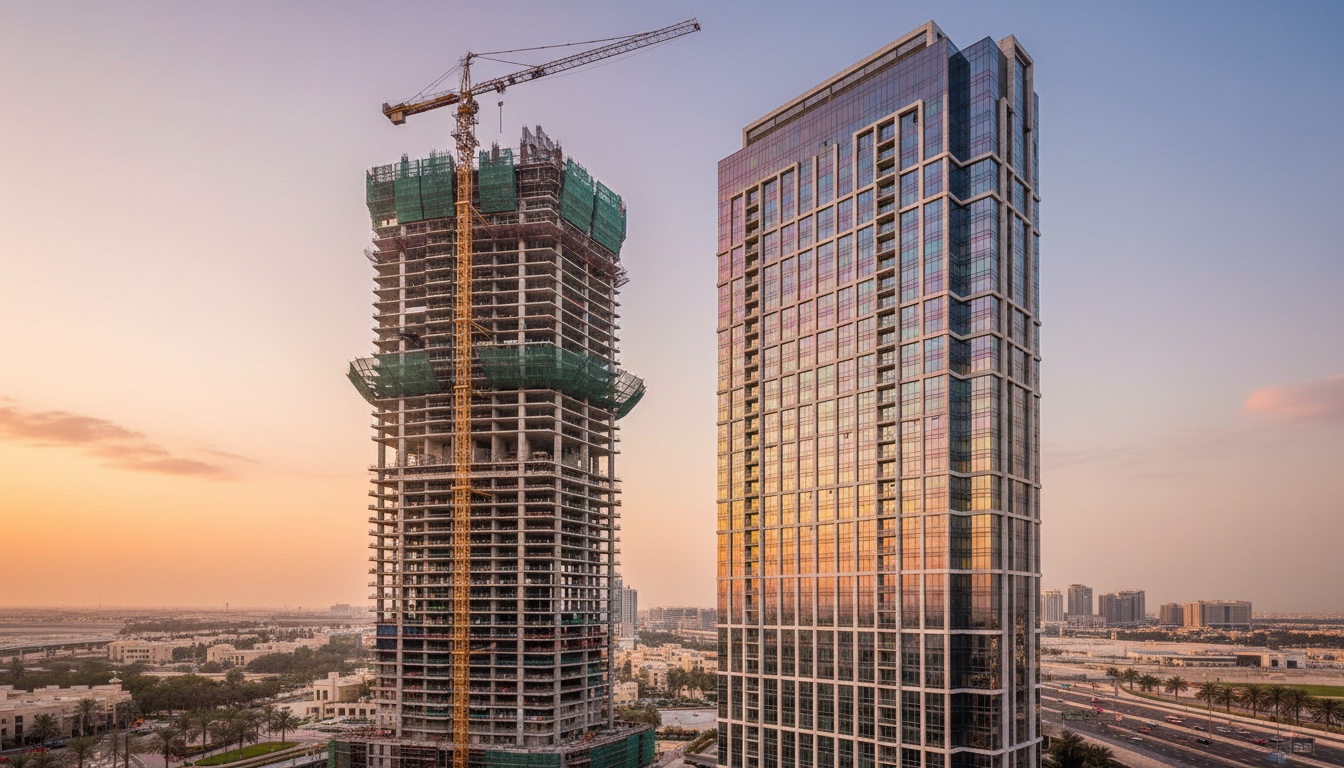
What off-plan and ready property mean in Dubai
Off-plan property in Dubai is a unit bought before completion and recorded in the DLD interim register, while ready property is a completed unit transferred to the buyer with a title deed. The difference is legal as well as physical, and it decides which documents you hold, where your money goes and how quickly you can use the unit.
An off-plan sale is registered by the developer. Under Law No. 13 of 2008, every sale of an off-plan unit must be entered in the Interim Real Property Register; a sale that is not registered is void. The DLD service for this is the initial sale registration, known in the market as Oqood, and it issues a provisional registration e-certificate rather than a title deed. The title deed comes at handover, when the building is complete.
Payments for a unit under construction do not go to the developer’s general account. Law No. 8 of 2007 requires payments by off-plan purchasers to be deposited in an escrow account opened for that project, and the account is dedicated exclusively to building it.
A ready property, also called a secondary or resale property, already exists. The buyer and seller sign a sale agreement, the seller obtains the developer’s no-objection certificate (NOC), and the transfer is registered at a DLD trustee centre. The DLD issues an electronic title deed in the buyer’s name on the day of transfer.
| Off-plan property | Ready property | |
|---|---|---|
| Status at purchase | Under construction | Completed |
| Who registers the sale | Developer, in the interim register | Buyer and seller, at a DLD trustee centre |
| Document you receive | Provisional registration e-certificate | Title deed |
| Where your money goes | Project escrow account, in stages | To the seller at transfer |
| When you can use the unit | After handover | From transfer |
In short: an off-plan buyer owns a registered right to a future unit, and a ready buyer owns the unit itself. Current developer projects are listed in off-plan and projects; completed units for resale are in secondary.
How much of the Dubai market is off-plan in 2026
Off-plan property made up about 68% of Dubai sales transactions in the first half of 2026: 58,840 off-plan deals against 27,160 deals for completed property, according to DLD figures reported on 20 July 2026. By value the split is almost even: AED 139.75 billion for off-plan and AED 146.69 billion for completed property.
That gap between count and value is worth reading carefully. By our calculation from the same DLD figures, the average off-plan deal in the first half of 2026 was about AED 2.4 million and the average completed-property deal about AED 5.4 million. This does not mean ready units cost twice as much as units under construction: the two groups contain different mixes of apartments, villas and locations, so the averages are not a like-for-like price comparison. What the figures do show is that off-plan accounts for most deals, while ready property carries about half of the money.
Resales of units still under construction are a much smaller part of the market than launches. Khaleej Times reported on 15 February 2026 that off-plan resales accounted for 9% of all off-plan transactions in 2025, so resales are a small share of the off-plan market.
Entry cost: developer payment plan vs paying in full
An off-plan purchase in Dubai spreads the price over a developer payment plan, while a ready property is paid in full at transfer, and both carry the same 4% DLD registration fee. The fee schedule is the same on both sides; what changes is when the rest of the money leaves your account.
Payment plans are set by each developer in the sale and purchase agreement (SPA). A 60/40 payment plan, for example, means 60% of the price is paid during construction and 40% on handover; post-handover plans move part of the price to the months after the keys. The plan is a contract term, not a DLD rule, so compare the schedule, not just the headline split.
The DLD fees on the two routes, from DLD service pages updated on 23 September 2026:
| Fee | Off-plan (initial sale, Oqood) | Ready (resale transfer) |
|---|---|---|
| Registration fee | 4% of the price: 2% seller, 2% buyer | 4% of the price: 2% seller, 2% buyer |
| Knowledge and innovation fees | AED 10 + AED 10 | AED 10 + AED 10 |
| Title deed issuance | At handover | AED 250 |
| Map fee | Not applicable | AED 250 for villas and apartments |
| Trustee centre fee | Not applicable (developer registers) | AED 4,000 + VAT for a sale of AED 500,000 or more; AED 2,000 + VAT below |
In words: the 4% registration fee applies to both, the map and trustee centre fees apply only to a ready transfer, and in both cases the DLD schedule splits the 4% equally between seller and buyer, while the contract decides who actually pays it. In 2026 some developers covered it: Khaleej Times reported on 20 August 2026 that developers were using DLD fee waivers, bulk discounts and higher broker commissions to support sales. A fee waiver is a price discount in another form, so compare the total cost, not the headline price.
Mortgage limits: 50% on off-plan vs up to 80% on ready
UAE banks may lend at most 50% of the value of an off-plan property, against up to 80% for an expatriate’s first ready home under AED 5 million. The limits come from the Central Bank of the UAE mortgage regulation (C 31/2013), and they apply to every bank in the country.
| Borrower and property | Maximum loan-to-value (LTV) |
|---|---|
| Off-plan property, any buyer and any value | 50% |
| Expatriate, first home, value up to AED 5 million | 80% |
| Expatriate, first home, value above AED 5 million | 70% |
| Expatriate, second and further homes | 60% |
The same regulation caps total debt repayments at 50% of the borrower’s income and the loan term at 25 years. In words: an expatriate buying a first ready home under AED 5 million can finance it with a 20% deposit plus fees, while an off-plan unit needs at least half of its value from the buyer’s own money.
Finance before completion also starts later. In the partnership announced on 16 April 2026 between Emirates NBD and Dubai Holding Real Estate (Meraas, Nakheel and Dubai Properties), a mortgage application is considered once the buyer has paid 50% of the price and the project has reached 30% construction; Gulf News reported that it is open to residents and non-residents. Bank conditions for other developers differ. The details are in our guide to getting a mortgage on an off-plan property in Dubai.
Rental income: when each option starts paying
Ready property can earn rent from the first month after transfer, while an off-plan unit earns nothing until handover. For an investor who needs income, this is the main difference between the two routes, and it lasts for the whole construction period.
The rent itself is not fixed. Cushman & Wakefield Core reported that rents across Dubai fell 6% quarter on quarter in the second quarter of 2026, with larger falls for apartments in Downtown Dubai (−14%), Dubai Hills Estate (−10%) and Dubai Marina (−10%). REIDIN’s rent index for Dubai was 5.04% lower in August 2026 than a year earlier. A buyer of a ready unit gets income immediately, but at today’s rent; a buyer of an off-plan unit will sign the first lease at whatever the rent is on handover day.
When you compare the two, compare net rent, not gross. Gross rental yield is the annual rent divided by the price; net yield subtracts service charges, maintenance, management and empty months. A ready unit also shows its real service charge history, while an off-plan unit’s service charge is only an estimate until the building runs.
Cash flow over three years: a worked example
Over a three-year build, a ready unit bought for AED 1,500,000 could collect about AED 270,000 in gross rent before an off-plan unit at the same price earns its first dirham. The example below uses the DLD fees above and our own assumptions; the assumptions are marked, and they are illustrations, not a forecast.
Assumptions (ours): both units cost AED 1,500,000; the off-plan unit is handed over after three years on a 10% / 50% / 40% plan (booking, construction, handover); the ready unit is bought with cash and let at a 6% gross yield, or AED 90,000 a year; the buyer pays the full 4% DLD fee in both cases.
| Year | Off-plan: paid in the year | Ready: paid in the year | Ready: gross rent received |
|---|---|---|---|
| 0 (purchase) | AED 150,000 + AED 60,020 DLD fees | AED 1,500,000 + AED 64,720 DLD, map and trustee fees | — |
| 1 | AED 250,000 | — | AED 90,000 |
| 2 | AED 250,000 | — | AED 90,000 |
| 3 (handover) | AED 250,000 + AED 600,000 | — | AED 90,000 |
| Total by handover | AED 1,560,020 | AED 1,564,720 | AED 270,000 |
In words: by handover both buyers have paid almost the same amount, but the ready buyer has also collected AED 270,000 of gross rent, while the off-plan buyer has kept most of the money in hand for longer.
What the example shows:
- Break-even on price. To match the ready buyer’s gross rent, the off-plan unit has to be worth about AED 1,770,000 at handover, or 18% above the purchase price, before costs and before counting what the off-plan buyer earns on cash not yet paid.
- Sensitivity to rent. At a 5% gross yield the ready unit collects AED 225,000 over three years and the break-even falls to 15%. Rents fell in 2026 (see rental income), so test more than one rent.
- What the example leaves out. Service charges, management and vacancy reduce the ready buyer’s income; a handover delay extends the off-plan buyer’s wait. Neither is fixed, so we did not assume a number.
The 2026–2027 handover wave: what it means for both options
Dubai expects about 55,600 new homes in 2026, the most since 2008, and more than 60,000 in 2027, according to Cushman & Wakefield Core’s first-half 2026 report as cited by Khaleej Times on 20 August 2026. More than 13,200 units were delivered in the second quarter alone, and about 32,000 are expected in the second half of the year.
The same report puts the pipeline to 2030 at nearly 525,000 planned units, of which only about 186,000 had passed 20% construction progress. A launch is not a delivery: most of the pipeline is still on paper, and some of it will move.
For a buyer choosing between off-plan and ready, the handover wave matters in two ways:
- For off-plan resale. When many units in one community are completed at the same time, ready units there compete for the same buyers and tenants as off-plan units that are about to be handed over. This is our reading of the supply data, not a forecast; check how many units are due in your community before you count on selling before handover.
- For ready rentals. New completions add rental supply, which is one reason rents fell in 2026 while sale prices fell less. Cushman & Wakefield Core reported sale prices down 4% quarter on quarter in the second quarter of 2026, against a 6% fall in rents.
Selling off-plan property before handover
An off-plan unit in Dubai can be resold before handover once the sale is registered in the interim register and the developer issues a no-objection certificate. The resale is also recorded in the interim register; a sale that is not recorded there is void under Law No. 13 of 2008.
Developers set their own resale conditions, and a developer can require a minimum share of the price to be paid before it issues an NOC. Meraas, for example, says resale can start once Oqood is issued, but a threshold amount must be met before the NOC can be requested; it does not publish the percentage. Find the threshold in your SPA or ask the developer before you buy if an early exit is part of the plan. We did not find official developer pages that publish NOC fees, so budget for an NOC fee that you confirm with the developer.
The price on resale is set by the market, not by the launch price. Khaleej Times reported on 15 February 2026 that, according to Knight Frank, secondary off-plan transactions in certain sub-markets had taken place at or below initial launch prices, with double-digit discounts reported in areas including Sobha Hartland, Damac Lagoons and Jumeirah Lake Towers; Knight Frank described these as isolated pockets rather than a systemic trend. A resale buyer also takes over the remaining payment plan, which limits the pool of buyers for units with a large balance still due.
Before you rely on a resale, check the price per square foot of actual transactions in the same building or community through DLD transaction data or the Dubai REST app, not the developer’s current list price.
Off-plan risks: delay, default and what escrow protects
The escrow account protects buyers’ payments from being spent on anything but that project, but it does not guarantee the handover date or the resale price. Escrow is a control on money, not on time.
The escrow rules work in stages. The DLD activates an escrow account against a bank guarantee for construction up to 20% completion, and after that releases funds according to the percentage of work completed, based on a DLD technical report no older than three months. Under Law No. 8 of 2007, once the developer obtains the completion certificate the escrow agent keeps 5% of the account, which is released one year after the units are registered to buyers. The DLD Project Status Enquiry service shows the completion percentage of a registered project on the DLD website, in the Dubai REST app and via WhatsApp; check it before each large payment.
What happens if an off-plan buyer stops paying
If an off-plan buyer in Dubai stops paying, the developer can terminate and keep up to 25% or 40% of the value, after the developer notifies the DLD and the DLD gives the buyer 30 days’ notice; the share depends on construction progress. The rules are in Article 11 of Law No. 13 of 2008 as amended by Law No. 19 of 2020:
- Above 80% complete: the developer may keep the contract and claim the balance, ask for a public auction, or terminate and keep up to 40% of the unit value.
- 60–80% complete: the developer may terminate and keep up to 40% of the unit value.
- Below 60% complete: the developer may terminate and keep up to 25% of the unit value.
The developer must refund all payments if work has not started for reasons beyond its control or if the Real Estate Regulatory Agency (RERA) cancels the project. For a ready property these risks do not exist in this form: the unit is complete, and the title deed is in your name from the day of transfer.
Myths about off-plan and ready property in Dubai
The belief that an off-plan unit is always worth more by handover is wrong: Knight Frank reported resales of units under construction at or below launch prices in some Dubai sub-markets (Khaleej Times, 15 February 2026). Other common myths:
- “Off-plan is always cheaper.” A lower headline price can hide a later payment date, a DLD fee waiver or a post-handover plan. Compare the price per square foot of recent DLD transactions in the same community, not two brochures.
- “Escrow makes a new-build purchase risk-free.” Escrow controls how the money is spent; it does not stop delays or price falls.
- “You can get an 80% mortgage on a unit under construction.” The Central Bank limit before completion is 50% of the value for every buyer.
- “A ready unit always pays its way.” Rents fell 6% quarter on quarter in the second quarter of 2026 (Cushman & Wakefield Core), and net rent is lower than gross.
- “Buying property gives you a visa automatically.” A residence visa is a separate application with its own conditions, explained in our guide to the UAE property residency visa.
Off-plan vs ready property: side-by-side comparison
Off-plan property vs ready property in Dubai comes down to three trade-offs: when you pay, when you earn and how much you can borrow. The table puts the facts from this guide side by side.
| Criterion | Off-plan property | Ready property |
|---|---|---|
| Payment | Staged, per developer payment plan | In full at transfer |
| DLD registration fee | 4% (2% + 2% under DLD schedule) | 4% (2% + 2%) plus trustee centre fee |
| Maximum mortgage | 50% of value, often only after a share is paid | Up to 80% (expatriate, first home up to AED 5 million) |
| Rental income | None until handover | From the first lease |
| Document | Provisional registration (Oqood) | Title deed |
| Main risk | Delay, resale below launch price, default penalties | Current rent and price, age and condition of the unit |
| Exit before completion | Resale with developer NOC | Normal resale |
| Share of Dubai sales, H1 2026 | About 68% of deals | About 32% of deals |
In words: buying before completion suits a buyer with time and staged cash, ready suits a buyer who needs income or a high loan now. When a developer offers a DLD fee waiver or post-handover plan, recalculate the total before comparing.
Pros and cons of off-plan and ready property
The main advantage of off-plan property is a staged entry into the market; the main advantage of ready property is rent and a title deed from day one.
Off-plan property — pros:
- Payments are spread over the construction period and sometimes beyond handover.
- Payments go into a project escrow account under Law No. 8 of 2007.
- Developers use incentives such as DLD fee waivers to support sales.
Off-plan property — cons:
- No rent until handover; the handover date can move.
- Bank finance is limited to 50% of the value and often starts only after a share of the price is paid.
- Resale depends on the developer’s NOC and on prices of competing completions.
- Default can cost up to 25% or 40% of the unit value.
Ready property — pros:
- Rent from the first lease, title deed on transfer day.
- Mortgage up to 80% for an expatriate’s first home under AED 5 million.
- You can inspect the unit, the building and its service charge history before buying.
Ready property — cons:
- The full price is due at transfer, plus the trustee centre fee.
- Current rents are falling: −6% quarter on quarter in Q2 2026.
- Older units can need maintenance and refurbishment.
Who off-plan or ready property is not a good fit for
Off-plan property does not suit a buyer who needs rental income or the money back within the construction period; ready property does not suit a buyer who cannot pay most of the price at once. Concrete cases:
- Off-plan, if you plan to resell before handover in a community with a large number of units completing at the same time. Resale depends on the developer’s NOC and competes with completed units nearby; Knight Frank reported resales at or below launch in some sub-markets.
- Buying before completion, if your payments depend on a mortgage before 50% is paid. The Central Bank limit is 50% of the value, and partner programmes such as Emirates NBD with Dubai Holding Real Estate start only after 50% payment and 30% construction.
- Buying before completion, if you cannot keep paying through a delay. Missed payments allow the developer to terminate and keep up to 25% or 40% of the value.
- Ready, if you count on the rent at today’s level for years. Dubai rents fell 6% in one quarter of 2026, and new completions add supply.
- Ready, if you want to avoid the cost of an existing building. A resale unit comes with its current service charge and its age; neither can be negotiated away.
Methodology and sources
All figures in this comparison were checked against primary sources on 25 September 2026: DLD service pages, Dubai legislation, the Central Bank of the UAE rulebook, Cushman & Wakefield Core, REIDIN and DLD transaction data as reported by the media. The cash-flow example uses the DLD fees in force on that date and our own assumptions, which are marked in the text. Average deal values are our calculation from DLD totals. We did not use listing portals or agency blogs as sources.
Sources:
- Dubai Land Department — Property Sale Registration; Request to Register the Initial Sale; Request to Activate an Escrow Account; Real Estate Project Status Enquiry (pages updated 23 September 2026).
- Law No. 8 of 2007 on escrow accounts (Art. 7, 9, 14); Law No. 13 of 2008 on the Interim Real Property Register (Art. 3); Law No. 19 of 2020 amending Art. 11 — Dubai Legislation Portal.
- Central Bank of the UAE — Regulations Regarding Mortgage Loans (C 31/2013), Article 3.
- Cushman & Wakefield Core — Dubai Residential MarketBeat Q2 2026 (24 July 2026).
- Khaleej Times — deliveries and pipeline, citing Cushman & Wakefield Core (20 August 2026); off-plan resales and Knight Frank comment (15 February 2026).
- Emirates 24/7 — DLD transactions for H1 2026 (20 July 2026).
- REIDIN — UAE Residential Property Price Report, August 2026 (11 September 2026).
- Gulf News — Emirates NBD and Dubai Holding Real Estate off-plan mortgage (16 April 2026).
Prepared by the East Property editorial team. Data as of 25 September 2026. Market figures are reviewed quarterly, when new DLD and Cushman & Wakefield data are published.
FAQ
Is it better to buy off-plan or ready property in Dubai?
It depends on cash and timing. Buying before completion spreads payments over the build but earns no rent until handover; ready property needs most of the price at once but can be rented out immediately and financed up to 80% for an expatriate’s first home under AED 5 million.
Is it worth buying off-plan property in Dubai in 2026?
It can be, if you do not need rent or a quick exit. Units under construction made up about 68% of Dubai sales deals in the first half of 2026, but some resales closed at or below launch prices, and about 55,600 new homes are expected to be completed in 2026.
Can I sell my off-plan property in Dubai before completion?
Yes, once the sale is registered in the interim register and the developer issues an NOC. A developer can require a minimum share of the price to be paid first; Meraas, for example, sets a payment threshold for its NOC. Check the threshold in your SPA or with the developer.
Is it safe to buy off-plan property in Dubai?
Payments are protected by a project escrow account under Law No. 8 of 2007, and the DLD releases funds according to construction progress. Escrow does not guarantee the handover date or the resale price, so check the project status in the DLD service before each large payment.
Is off-plan property cheaper than ready property in Dubai?
Not always. A lower headline price can reflect a later payment date or a DLD fee waiver. Compare the price per square foot of recent DLD transactions for similar units in the same community.
Can I get a mortgage on off-plan property in Dubai?
Yes, but the Central Bank of the UAE caps the loan at 50% of the value for a unit bought before completion. Banks often lend only after a share of the price is paid; for example, Emirates NBD with Dubai Holding Real Estate considers applications after 50% payment and 30% construction.
What is the 4% DLD fee?
It is the Dubai Land Department registration fee: 4% of the price, split 2% seller and 2% buyer in the DLD schedule. It applies both to the initial sale of a unit under construction and to the transfer of a ready unit; the contract decides who actually pays it.
Will property prices fall in Dubai in 2026?
Prices have already eased: Cushman & Wakefield Core reported a 4% quarter-on-quarter fall in the second quarter of 2026, and REIDIN’s sales index was 0.77% lower year on year in August 2026. We do not forecast prices; the highest handover volume since 2008 is the factor to watch.
What happens if I stop paying for an off-plan property?
After the DLD’s 30-day notice, the developer may terminate and keep up to 25% of the unit value if the project is below 60% complete, and up to 40% if it is 60% complete or more; above 80% the developer may also claim the balance or request an auction.
When does off-plan property start earning rent?
Only after handover, when the title deed is issued and the unit can be leased. Until then the buyer pays instalments with no rental income.



 Bookmark your favorites
 Get updates about new listings