

How to check a developer in Dubai and an off-plan project: the risks associated with new-build properties in the UAE
In 2024, the Dubai Land Department fined three property developers 500,000 dirhams each for advertising and selling flats in projects that had not been registered. Buyers of these flats made payments into accounts that were not protected by the escrow law. Yet the check to distinguish a registered project from an unregistered one takes just ten minutes on the Dubai REST app and costs nothing.
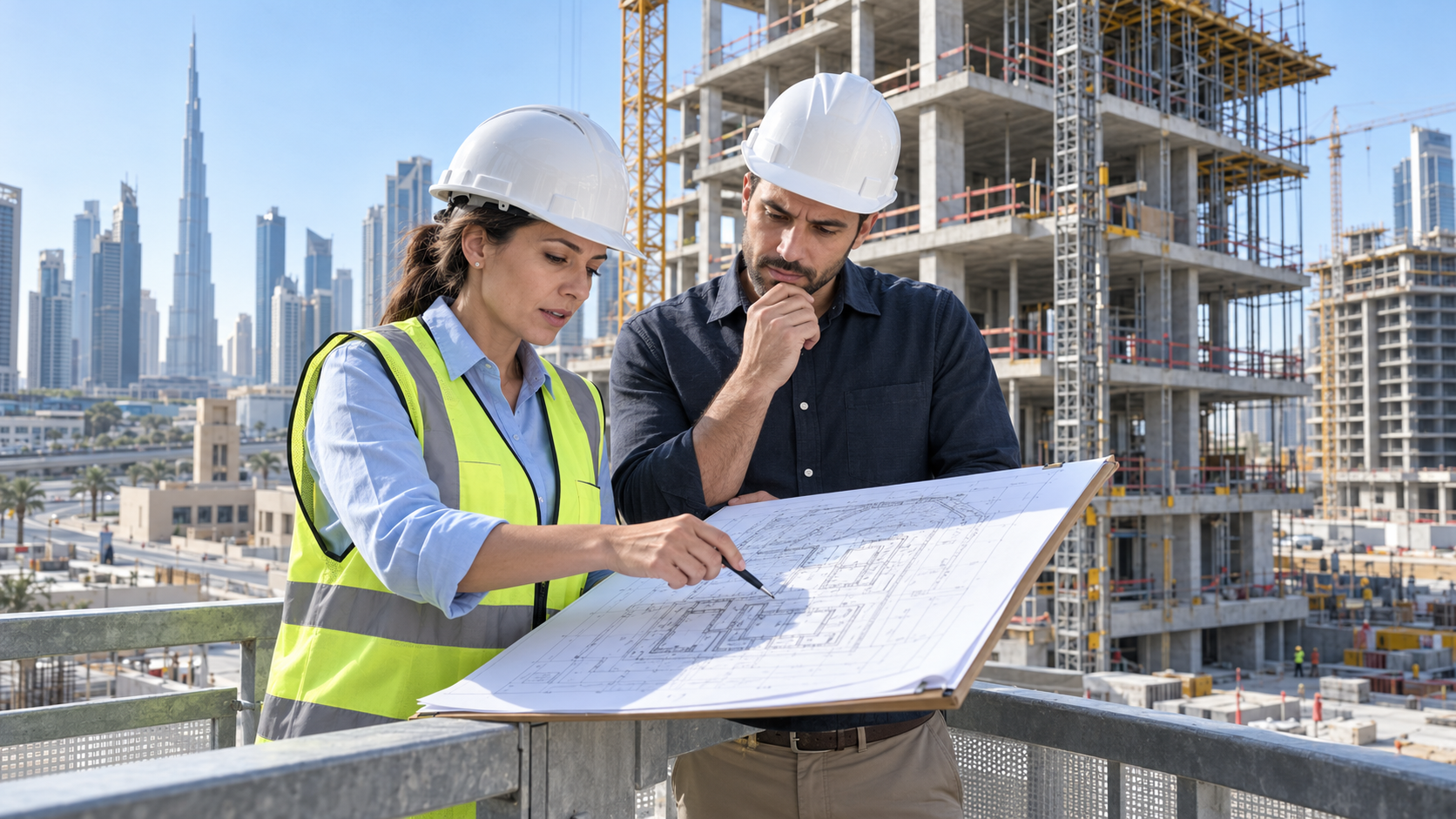
Around 70 per cent of residential property transactions in Dubai in 2026 take place whilst the property is still under construction. The buyer protection system here is more stringent than in most markets: funds are only accepted into the project’s escrow account; the developer receives them in instalments following verification by an independent engineer; and the completion status of each project is published by the government, complete with photographs and the date of the last inspection. However, this protection only applies to projects included in the system, and it is the buyer’s responsibility to verify this.
In this article, we provide a practical checklist comprising four sections: the developer, the project, the money and the contract, and the financials. For each point, we indicate the official service where it can be checked, and what constitutes a satisfactory response. At the end, we analyse a specific project against this checklist as of September 2026 and provide a list of red flags that indicate you should not proceed with a booking. Legal issues relating to a specific transaction should be confirmed with a lawyer in the UAE.
What protects the buyer under the law
Protection for buyers of off-plan property in Dubai is based on two laws and one regulation, and this checklist verifies whether this protection applies to a specific project. The Escrow Accounts Law No. 8 of 2007 requires that all buyers’ funds be paid into a separate project account at an approved bank, and that the developer receive these funds in instalments as construction progresses, following confirmation by a consulting engineer. Five per cent remains in the account for a further year after the building is handed over. What else you need to know:
- Provisional register. Law No. 13 of 2008 requires every contract for a flat under construction to be registered with the Oqood register. An unregistered contract does not confer any rights on the buyer, and the developer faces a fine of 10,000 dirhams for each such contract.
- Conditions for the start of sales. Since 2018, before sales can begin, the developer must pay for the land in full and deposit 20 per cent of the project’s value into an escrow account or provide a bank guarantee for this amount.
- Advertising only with authorisation. A project may only be sold or advertised after registration with the DLD and obtaining authorisation via the Trakheesi system. The authorisation number must be stated in every advertisement.
- Fines. Breaching the escrow law carries a fine of 100,000 dirhams and criminal liability. Selling without registration carries fines of up to 500,000 dirhams, as per the 2024 ruling, and removal from the register.
- Completion deadline. The law does not set a maximum construction period. The date is taken from the contract; if no date is specified, the court will determine a reasonable timeframe itself. This means that the date and any permissible delay specified in the contract take precedence over any verbal promises.
Official services for verification
All the data for the checklist is available from open government sources, and there is almost no need to rely on information provided by the developer on trust. The main tool is the Dubai REST app from the Land Department, where the project status section shows registration details, the escrow account, the percentage of completion as per the consultant’s inspection, and photographs from the construction site. What to look for and where:
| Service | What it shows | How to use |
|---|---|---|
| Dubai REST, project status | Project registration, developer, escrow account bank, percentage of completion, date and photos of the latest inspection, scheduled handover date | Search by project name or developer, without logging in |
| DLD Register of Developers | Is the developer registered? Their registration number and status | Section on approved developers on the DLD portal |
| Trakheesi | Project advertising licence number and estate agent’s profile | The number from the advert is verified via Dubai REST |
| List of escrow banks | Is the bank where the project account is held approved? | Published by the DLD |
| RERA maintenance fees register | Prices for completed properties by the same developer and in the same area | DLD portal or Dubai REST |
| DLD transaction data | Actual registration prices in the area for comparison | Publicly available transaction statistics |
| Building permit | Issued by the municipality or Trakhees for free economic zones | Requested from the developer, verified by reference number |
Developer verification
Checking the developer’s track record reveals whether they have previously completed properties on time and within what timeframe. Registration with the DLD is a necessary but not sufficient condition: there are hundreds of registered developers in Dubai, but significantly fewer with a history of on-time completion. The most reliable source is the developer’s past project records in Dubai REST, which show both the stated and actual handover dates. What to check:
- Registration. The developer is listed in the DLD register, their status is active, and the registration number matches that stated in the contract and advertising.
- Completed projects. How many buildings have been completed, when, and how long the delay was compared to the stated date. A delay of up to a year on a single project is standard for the market; delays across all projects indicate a systemic issue.
- Current workload. How many projects the developer is building simultaneously and at what stage each one is. Five projects at the ground-breaking stage for a developer with only two completed buildings is a risk.
- Own resources. Does the developer have its own construction division or a reputable main contractor, and has a consulting engineer been appointed for the project?
- Land. Is the plot registered in the developer’s name, rather than that of a third party, and has it been paid for in full?
- Reputation in disputes. Court rulings and buyer complaints regarding past projects, particularly concerning refunds and the quality of finishes.
Project verification
The project should be checked independently of the developer, as even a reputable developer may have an unregistered project whilst in the tender stage. No money should be paid – apart from a refundable reservation deposit – until the project has been registered and an escrow account has been opened. What to check regarding the project:
- Project registration with the DLD. The project is listed on Dubai REST with its own number, has an ‘active’ status, and the developer listed on the project details matches the seller.
- Escrow account. The project details list a bank from the approved list and an account number. The account details in the contract and in the project details must match exactly.
- Building permit. Issued by Dubai Municipality or Trakhees if the plot is within a free economic zone. Construction cannot begin without it.
- Master developer’s approval. For projects within large communities, a letter from the community owner is required.
- Percentage of completion and inspection date. For a new development, this will be zero, which is normal. For a project that has been on the market for over a year, there should be progress between inspections. Two quarters without any progress is a warning sign.
- Advertising authorisation. The Trakheesi number must appear in adverts and be provided by the estate agent marketing the development.
- Number of flats. The number of flats approved by the DLD matches the number on sale. Cases have been reported where more flats were sold than were registered.
Money and the contract
Even with a registered development, a buyer can lose their protection with a single transfer to the wrong account. All payments, including reservation fees after the development’s registration, must be made exclusively to an escrow account specifying the flat number. What to check in the contract and the payment schedule:
- Payee. The escrow account details in the contract must match those in Dubai REST. If the account belongs to the developer’s operating company, a broker or a third party, the transaction must be cancelled.
- Payment schedule and construction stages. A plan whereby 70–80 per cent is paid before the structural framework is in place shifts the risk onto the buyer. Linking payments to stages of completion offers better protection than linking them to specific dates.
- Reservation deposit prior to registration. If the project is accepting applications before the official launch, the deposit must be refundable, with written terms specifying the conditions and timeframe for a refund.
- Permissible delay. Typically up to 12 months without penalties. Beyond that, compensation or the right to terminate the contract applies, and this must be explicitly stated, not merely implied.
- Floor area. The floor area sold must be as per the documents, including the permissible deviation and the procedure for recalculating the price in the event of a discrepancy.
- Termination. What happens if the buyer defaults: by law, the developer retains a portion of the payment made, depending on the project’s stage of completion, and the contract cannot worsen this provision.
- Assignment. Is it possible to sell the flat before completion; after what proportion of payments have been made; and what fee is payable to the developer?
- Oqood registration. A 4 per cent fee and the registration timeframe following signature. The certificate must be provided within the first few weeks.
Project economics
A registered project from a reputable developer may be overvalued, and this is also part of the due diligence process. The price per square metre in a new-build is compared with the registered prices of completed properties in the same area, rather than with the developer’s presentation. What to consider:
- Price per metre compared to completed properties. DLD transaction data for the area over recent months. A 10–20 per cent premium for a new-build over a completed property is justifiable due to the finish and payment plan; a 40–50 per cent premium is not.
- Service charges. The rates for the developer’s completed buildings and the neighbourhood as listed in the RERA register. Promised ‘low service charges’ should be verified by checking with neighbours.
- New supply in the area. How many flats are being let in the area in the year the development is completed. Five towers being completed simultaneously means competition for tenants in the first year.
- Exit liquidity. The number of transactions in the area and the rules on assignment. A development from which you cannot exit before handover requires a holding period until keys are handed over.
- Discounts and ‘gifts’. Exemption from the DLD fee, guaranteed returns, free furniture – all of this is factored into the price, so you need to compare prices excluding these ‘gifts’.
A single checklist
Twelve points covering four sections. The order is important: the first four points weed out projects where you shouldn’t pay at all; the rest answer the question of whether it’s worth it. What you need to obtain before submitting an application:
- The developer must be listed in the DLD register, and the registration number must match that on the contract.
- The project must be listed in Dubai REST with ‘active’ status.
- An escrow account with an approved bank, with details matching those in the contract.
- A building permit and approval from the master developer.
- The Trakheesi authorisation number must be included in the advertisement and held by the estate agent.
- The developer’s track record of handover dates based on previous projects.
- Percentage of completion and inspection date for projects on sale for more than a quarter.
- A payment schedule linked to construction stages, not just to dates.
- Contract terms covering delays, floor area, termination and assignment.
- Price per square metre compared to completed properties in the area.
- Service charges for the developer’s completed buildings.
- Number of new properties completed in the area in the year of handover and the number of transactions.
Example analysis: The Archive by Imtiaz
Let’s go through the checklist for a project which, as of September 2026, is at the very earliest stage — the collection of applications prior to the official sales launch. This is The Archive by Imtiaz Developments in the Dubai Land Residence Complex, Dubai Land: a building with thirteen residential floors on three podiums, offering studios and one- to three-bedroom flats, fully finished and furnished, with a stated handover date in the third quarter of 2028. The early stage is the most telling example, because some of the points cannot be verified at this stage, and this in itself is the result of the verification. Here are the findings of the block-by-block verification as at the date of writing:
| Point | What is known | Verification status |
|---|---|---|
| Developer | Imtiaz Developments, operating since 1993; the project documentation states the DLD registration number as 1129 | The number is verified in the DLD register of developers |
| Handover history | According to the developer, there are more than 40 projects and over 2,000 completed flats; among those completed are RAW District I and II on Sheikh Zayed Road | Completion dates for previous projects can be verified via the records in Dubai REST |
| Project registration | The project is currently in the application collection phase; sales have not officially opened | Before sales commence, the project number and escrow account details must appear in Dubai REST; until then, only a refundable deposit is payable |
| Escrow account | The documentation states that funds are held in an escrow account registered with the DLD | Request the bank and account number and check them against the project brochure on the day sales commence |
| Reservation fee | According to the published terms, 50,000 dirhams for a studio, 80,000 for a one-bedroom flat, and 100,000 for a two- or three-bedroom flat | Obtain the refund terms and timeframe in writing before making the transfer |
| Payments | 20 per cent plus a 4 per cent DLD fee and an administration fee upon booking; followed by a 50/50 payment plan until handover, or a 60/40 plan with 40 per cent payable within three years of handover | The 60/40 payment plan transfers part of the risk to the period after handover, which is to the buyer’s advantage |
| Contract | The text has not been published prior to the start of sales | Delays, floor area, termination and assignment are to be verified against the draft contract prior to signing |
| Price | Studio flats from 666,000 dirhams according to the published terms | Compare with registrations for completed studios at the Dubai Land Residence Complex for summer 2026 |
| Fees | This is a new development; the fee structure has not yet been approved | As a guide, refer to the rates for completed Imtiaz properties in the RERA register |
| Development in the area | The area continues to be developed, with completed buildings and new developments nearby | The volume of units to be handed over in 2028 should be verified against DLD data before making a decision |
Conclusion based on this example: four of the first five points can only be verified after the official sales launch, when the project and the escrow account appear on Dubai REST. This is not a shortcoming of the project, but a characteristic of the early stage. The correct course of action for a buyer at this stage is to pay only a refundable deposit with a written condition, wait for registration, verify the details of the escrow account, and only then sign the contract and pay the first instalment. A developer with a track record of completions and its own construction division gives reason to expect successful registration, but reason and confirmation are two different things.
Red flags
Some warning signs are visible even before any checks are carried out, and if they appear, there is no need to go through the rest of the checklist. What should stop you from making a booking:
- The project is not listed on Dubai REST, and the seller explains this by saying it will be ‘registered in the next few days’.
- Payment is made to the account of the developer, a broker or a ‘partner’ instead of an escrow account.
- There is no Trakheesi authorisation number in the advert, or the estate agent does not show their RERA card.
- According to inspection data, the project’s progress has not increased for two consecutive quarters.
- The stated completion date is shorter than the typical cycle: a 20-storey building to be completed within a year and a half from ground-breaking.
- The contract lacks a handover date or does not allow for a reasonable delay.
- A guaranteed return higher than the market rate for several years, included in the price.
- Time pressure: ‘only three flats left’, ‘the price will go up tomorrow’, ‘sign now’.
- A discount for payment bypassing escrow in any form.
What to do if the due diligence fails
A discrepancy on a single point does not always mean rejection, but requires an explanation backed up by a document, not just words. How to proceed:
- The project cannot be found on Dubai REST. Ask the developer for the project’s registration number and date; if the project is genuinely at the application stage, pay only a refundable deposit.
- The escrow account details do not match. Stop the payment and request a letter from the bank confirming the opening of an escrow account for this project. Check against the details on the card in the app.
- Delays in previous projects. Find out the reason and how it was resolved with the buyers. Compensation under the contract is one thing; legal disputes are another.
- The terms of the contract are less favourable than the law. Clauses that place the buyer at a disadvantage compared to Laws No. 13 of 2008 and No. 19 of 2020 are contestable, but it is best to have them removed before signing.
- The reservation fee is non-refundable. Lodge a complaint with RERA via the DLD portal, attaching proof of payment and correspondence.
Outside Dubai
The checklist is standard across all emirates, but the services and regulatory bodies vary. In Abu Dhabi, project registration and escrow accounts are managed by the Abu Dhabi Real Estate Centre via the DARI platform, where the developer and the project are vetted. Ras al-Khaimah has its own real estate regulatory authority with a register of projects and escrow accounts held at approved banks. In Sharjah and the northern emirates, verification is carried out through local land departments, and the level of open data available there is lower than in Dubai; consequently, the proportion of enquiries directed at the developer is higher. The rule requiring payment to be made only into the project’s escrow account applies in all emirates with escrow legislation.
Frequently Asked Questions
Where can I check whether an off-plan project is registered in Dubai?
In the Land Department’s Dubai REST app, under the ‘Project Status’ section, by project name or developer, without logging in. The details page shows the registration status, escrow account, percentage of completion and date of the last inspection.
Can I pay the developer before the project is registered?
Only a refundable reservation deposit with a written refund clause. Any payments under the contract must be made to an escrow account, which is set up once the project has been registered. Transfers to any other account are not protected under the escrow law.
How can I check the project’s percentage of completion?
In the project details on Dubai REST. The percentage is determined by an independent consulting engineer based on inspection results, not by the developer, and is updated as each stage is completed. The page also includes photos from the construction site and the inspection date.
What happens to the money if the project is cancelled?
If the project is cancelled by the regulator, the escrow account is frozen, an auditor is appointed, and the money is returned to buyers in proportion to the amounts paid as per the documentation. This protection applies only to payments made into the escrow account and under registered contracts.
How long does the verification process take?
The first five items on the checklist take ten to fifteen minutes to check on Dubai REST and the DLD portal. The developer’s track record and the project’s financials take one to two days, including time to request documents. The contract is a job for a solicitor and usually takes several days.
Does a reputable developer guarantee a reliable project?
No. Registration and the escrow account are checked separately for each project, because a registered developer may have a project at the application stage that is not yet registered. A track record of successful completions reduces the risk, but does not replace a check on the specific project.
What’s important to remember
- Protection only works within the system. The escrow account, project registration and Oqood protect the buyer if the project is included in them, and only the buyer themselves can verify this.
- Dubai REST covers half the checklist. Registration, the escrow account, the percentage of completion, the inspection date and photos — all free of charge and without the need to log in.
- The first five points determine whether you should pay. The remaining seven determine whether it is worth it.
- The early stages are no reason to take anyone’s word for it. Before registration, only a refundable deposit with written terms, a contract and the first payment – after the project appears in the register.
- Bank details must be checked word for word. Using the operating company’s account instead of an escrow account leaves you unprotected with a single transfer.
- A developer’s track record is assessed through details of past projects, not through a presentation: compare the stated date with the actual date.
Check the project before you submit an application
We go through this checklist for every project we offer and send the results in the same format as the example in the article: known details, verification status. We verify the developer’s and project’s registration, the escrow account and the handover history via Dubai REST and the DLD registers; we review the contract with a solicitor before the buyer sees it, and we compare the price per square metre with recent registrations of completed properties in the area over the past few months.
Take a look at our listings in the UAE and submit an enquiry: we’ll select off-plan projects to suit your budget and timeframe, and send you a 12-point checklist for each one.


 Bookmark your favorites
 Get updates about new listings