

Property Visa in Dubai: Thresholds, Documents and How the Golden Visa Differs from the 2-Year Visa
A property visa in Dubai no longer requires a minimum purchase price for a sole owner as of April 2026, while joint owners must each hold a share worth at least AED 400,000; separately, the 10-year Golden Visa from AED 2 million remains unchanged and is issued by the Dubai Land Department (DLD). Both routes are tied to ownership of a specific unit, not to buying property in general, and they are not interchangeable.

What changed in April 2026: the AED 750,000 threshold is gone
The Dubai Land Department (DLD) removed the AED 750,000 minimum property value for a sole owner applying for the 2-year property investor visa (DLD, April 2026). Before this update, an applicant had to own real estate worth at least AED 750,000 to qualify; now, for an individual who is the sole registered owner of a unit, there is no minimum value at all — a studio priced well under the old threshold now qualifies, provided the property itself exists on the market.
The change is processed through the DLD Cube digital platform and applies specifically to the entry-level investor visa tied to real estate — it does not touch the Golden Visa, and it does not change the rules for off-plan reservations, mortgaged units, or joint ownership, which are covered separately below.
Who qualifies without a minimum amount: the sole-owner rule
Only a sole owner — someone whose name alone appears on the title deed registered with DLD — qualifies for the visa without any minimum property value. The word “sole” matters here: if the title lists a single individual as owner, the price of the unit no longer plays any role for the 2-year investor visa.
In practice this means the AED 750,000 figure that anchored the Dubai property market for years no longer applies to this category of applicant. Ownership still has to be registered: at the reservation stage of an off-plan unit, before Oqood registration and full title transfer, the visa cannot be issued regardless of how much has already been paid to the developer.
Joint ownership: AED 400,000 per co-owner
Where a property is registered to more than one owner, each co-owner must hold a share worth at least AED 400,000 to qualify for the visa (DLD, April 2026). This replaces the earlier rule that measured the combined value of the whole unit against the AED 750,000 threshold for all co-owners together.
According to published clarifications, the rule was introduced to prevent “visa pooling” — attempts to secure residency for several people through one low-value unit. The practical takeaway: a couple planning to apply jointly on a single property should check the value of each individual’s share, not the total price of the apartment.
The AED 2 million Golden Visa: what changed in February 2026
The Golden Visa threshold itself has not moved and remains at AED 2,000,000 by DLD valuation, but in February 2026 the requirement to pay a fixed share of the price before applying was removed. Previously, an applicant financing the purchase with a mortgage had to pay at least 50% of the property’s price before submitting a Golden Visa application; after the change, the application is assessed against the property’s value as certified by DLD, not against the amount already paid.
Important: sources describe the mortgaged-property mechanics somewhat differently — some frame it as the full DLD-certified value counting toward the AED 2 million threshold, others describe it as counting only the paid-up equity. Before applying, confirm the current interpretation directly through DLD Cube or a licensed consultant rather than relying on a single blog post.
Mortgaged properties additionally require a bank no-objection certificate (NOC); off-plan properties require developer confirmation and count at the full Oqood contract value, even if only part of it has actually been paid.
The 2-year investor visa vs. the Golden Visa: what’s actually different
The 2-year investor visa and the 10-year Golden Visa are two separate products with different thresholds, durations and conditions, not two versions of the same visa. Confusing the two is the source of most of the misunderstanding around “buying property for a Dubai visa.”
Antifake: the threshold removed in April 2026 applies only to the 2-year investor visa. The Golden Visa threshold — AED 2,000,000 — was not touched by this change and remains the same.
The 2-year status renews indefinitely as long as ownership is maintained, but it comes with a stricter absence rule (see below). The Golden Visa runs for ten years, lets the holder sponsor a spouse and children, and sets no minimum time the holder must spend in the UAE — the full side-by-side comparison is in the table further down.
Which properties qualify: ready, off-plan and mortgaged
Both visas accept ready and off-plan (under-construction) property, as well as units carrying an outstanding mortgage — provided the value is confirmed by DLD and, for a mortgage, the bank issues an NOC. This applies to both the 2-year visa and the Golden Visa, though the verification details differ.
For the 2-year investor visa, the key condition after the April changes is sole, registered ownership — the price is irrelevant. For the Golden Visa, since February 2026, an off-plan unit counts at its full Oqood contract value and a ready unit at its DLD valuation — so an applicant can qualify even if an under-construction project has not been fully paid for, as long as the contract value exceeds AED 2 million.
Several lower-value properties can be combined to reach the AED 2 million Golden Visa threshold, where the application process allows it. This matters for investors whose holdings are split across two or three smaller units rather than concentrated in one large asset; check with DLD or a licensed consultant whether combining contracts is accepted in your specific case, since the aggregation rules are refined periodically by the regulator.
How to apply for a property visa in the UAE: step by step
Applying for a property visa starts after the title (or an Oqood contract) is registered with DLD — not after signing a reservation agreement or paying the first instalment to a developer. This is one of the most common points of confusion for foreign buyers who expect the visa process to begin as soon as the sale closes.
The general sequence:
- register the title deed, or the Oqood contract for an off-plan unit, with DLD;
- obtain a property status certificate and, where a mortgage exists, a bank NOC;
- submit the visa application through DLD Cube (Taskeen for the 2-year visa; the Golden Visa e-service for the 10-year visa);
- complete the medical test and biometrics;
- receive the residence visa and Emirates ID.
According to immigration consultants and the DLD’s own service pages, a property-linked residence visa is typically processed within 10 to 21 working days of a complete application — the exact timeline depends on the visa centre’s workload and how complete the submitted package is.
What a property visa costs beyond the price of the unit
The property price is not the only expense: a visa fee, medical test, Emirates ID issuance and, where used, a typing-centre or legal-consultant fee are all charged separately. None of these fall inside the AED 750,000 figure (now removed for sole owners) or the AED 2 million Golden Visa threshold — they are a distinct line in the transaction budget.
Official DLD figures put the total government fee for the 10-year Golden Visa investor route at roughly AED 9,884.75, covering DLD processing, administrative fees, visa issuance, Emirates ID and the medical test — the same components apply whichever visa is issued, only the totals differ. For the 2-year investor visa, independent trackers cite a new-application cost in the region of AED 10,000–10,500 and a renewal fee closer to AED 8,000–8,500 every two years; these figures move with government fee schedules, so confirm the current amount on the DLD Taskeen page before budgeting.
When planning the budget, add these visa costs alongside the 4% DLD registration fee, the agency commission and, for a mortgaged unit, the bank’s NOC fee — otherwise the true cost of reaching visa status ends up higher than expected.
| Cost item | What it is | Who typically pays |
|---|---|---|
| 4% DLD transfer fee | Charged on registration of the title | Usually the buyer, sometimes split with the seller |
| Agency commission | Brokerage fee on the transaction | Buyer or seller, by agreement |
| Visa fee and typing centre | Application submission, visa issuance | Applicant |
| Medical test and biometrics | Mandatory step for a residence visa | Applicant |
| Emirates ID | Resident identification card | Applicant |
| Bank NOC (mortgaged property) | Bank confirmation required for the Golden Visa | Applicant, per the bank’s tariff |
What a property visa does not give you: citizenship, a passport, or the right to work
Neither the 2-year investor visa nor the AED 2 million Golden Visa grants UAE citizenship or replaces a passport from this country — both are residence visas that renew or lapse together with ownership of the underlying property. This is the single most common — and most consequential — misconception around the topic.
Antifake: buying property in the UAE does not grant citizenship at any price point — not at AED 750,000, and not at AED 2 million. It grants a residence visa tied to ownership of a specific asset.
Antifake: a property visa is tied to the asset, not issued once and for all. Selling the unit that the visa was based on ends the resident status attached to it.
It is also worth noting that a residence visa on its own does not authorise employment with an outside employer in the UAE — working for a salary requires a separate work permit, unless the resident plans to live on passive income or savings rather than local employment.
Where to look for property under the visa threshold in Dubai
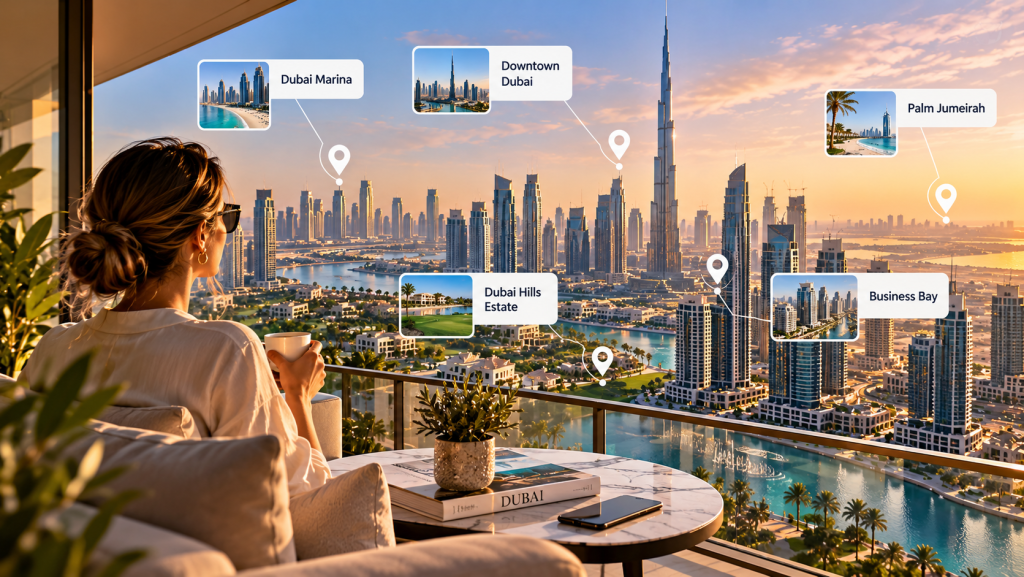
For the 2-year visa, almost any solely owned unit now qualifies after the threshold was removed, but for joint owners and for the Golden Visa the value of the share or the unit still needs to be checked in advance. East Property has ready-made filters by price and district for exactly this purpose.
Projects priced up to AED 750,000 are easy to browse in the projects section with a price filter — still a sensible benchmark for anyone planning a joint application at the AED 400,000-per-person threshold. The districts with the largest supply of budget ready and off-plan units are Jumeirah Village Circle, Arjan and Dubailand. For buyers considering a below-market entry point, there is a separate section for discounted and distressed property — though visa eligibility is always based on the registered value of the unit, not the price the two sides agreed between themselves.
Comparison: the 2-year visa, the Golden Visa, and living in the UAE without buying
The 2-year investor visa and the Golden Visa differ on entry threshold, duration, absence rules and the ability to include family — and neither one is a substitute for citizenship.
| Parameter | 2-year investor visa | Golden Visa (10 years) |
|---|---|---|
| Minimum value | None for a sole owner; AED 400,000 per co-owner | From AED 2,000,000 by DLD valuation |
| Issuing authority | DLD, via the Cube platform | DLD / GDRFA |
| Validity | 2 years, renewable | 10 years, renewable |
| Upfront payment requirement | None | None since February 2026; a bank NOC is required for mortgaged units |
| Off-plan and mortgage | Allowed with Oqood registration / NOC | Allowed with Oqood registration / NOC (since February 2026) |
| Family sponsorship | Limited | Spouse, children, in some cases parents |
| Absence rule | No more than 6 consecutive months outside the UAE | No minimum stay requirement |
| UAE citizenship | Not granted | Not granted |
Antifake: holding a residence visa does not mean an unlimited right to stay away from the country. Under the 2-year investor visa, being outside the UAE for more than 6 consecutive months can lead to cancellation of the visa.
Pros and cons of a property visa in the UAE
The main upside of the April and February 2026 changes is a lower effective entry point, but the visa still depends entirely on the status of a specific property, not on the amount invested in the market overall.
Pros:
- the entry threshold for a sole owner is effectively removed — what matters is the price of the specific unit, not a fixed AED 750,000 figure;
- the residence visa is issued without an employer sponsor, based purely on ownership of the asset;
- the Golden Visa sets no minimum time in the country and allows family sponsorship;
- since February 2026, mortgaged and off-plan units no longer face a large-upfront-payment requirement for the Golden Visa application.
Cons:
- the status lasts only as long as ownership does — selling the asset ends it;
- mortgaged and off-plan units still require extra paperwork — a bank NOC or developer confirmation;
- the 2-year route requires observing the 6-month continuous-absence rule;
- neither threshold grants citizenship or an automatic right to paid employment.
Who a property visa is not a good fit for
A property visa does not solve problems that require a different legal status: it does not substitute for citizenship, it requires attention to ownership structure, and it does not suit a short time horizon in the country.
- The goal is citizenship or a second UAE passport: neither the threshold-free 2-year visa nor the AED 2 million Golden Visa grants citizenship under any circumstances.
- Plans to spend less time in the UAE than the 2-year visa allows: if total absence exceeds 6 consecutive months, the status can be cancelled.
- The purchase is structured through a foreign company rather than an individual: residency is issued to the individual owner on title, not to a company, even where the ultimate beneficiary is the same person.
- The asset carries a substantial outstanding mortgage and the bank is not prepared to issue an NOC: without that document, an application on that unit will not be accepted.
Sources and fact-checking methodology
Sources
The removal of the AED 750,000 sole-owner threshold and the AED 400,000 joint-ownership rule are described in the official DLD Cube service page «2 Years Residence Visa for Property Owners» and the Dubai Land Department — Investor Residence Application (Taskeen) e-service; the change was independently reported by KPMG’s GMS Flash Alert 2026-125 and by immigration-industry trackers. The unchanged AED 2,000,000 Golden Visa threshold and the removal of the upfront-payment requirement are described in the DLD Golden Visa (Investor) e-service and the GDRFA — Issuing a golden residence permit (investors) service description. The official government fee total for the Golden Visa (AED 9,884.75) comes from the same DLD e-service page. Last fact-check by the East Property editorial team: 15 September 2026.
Methodology
Every number in this article tied to fees, visa thresholds or timelines is checked against at least two independent sources where possible and dated. Points where sources disagree in detail — such as how the paid-up share is counted for mortgaged Golden Visa applications — are flagged separately and require confirmation through DLD or a licensed consultant before filing. This page is scheduled for review at least once a quarter as regulation evolves.
This article covers the real-estate route to UAE residency only. The Golden Visa programme also has separate tracks for entrepreneurs, public investors, specialists and outstanding students, each with its own criteria — those are outside the scope of this guide.
Frequently asked questions about the property visa in the UAE
Does buying property in the UAE grant citizenship?
No. Neither the 2-year investor visa nor the Golden Visa grants UAE citizenship at any property value — both are residence visas tied to ownership of real estate.
What is the minimum amount needed for a property visa in 2026?
For a sole owner, the 2-year investor visa has had no minimum value since April 2026; for joint owners, each must hold at least AED 400,000. The Golden Visa threshold remains at AED 2,000,000 by DLD valuation.
Which is better — the 2-year investor visa or the Golden Visa?
They serve different purposes: the 2-year visa has a lower entry point but requires observing the 6-month absence rule and renewing every two years; the Golden Visa costs more to qualify for but runs for 10 years, sets no minimum stay, and allows sponsoring more family members.
Can I get a property visa on a mortgaged unit?
Yes, for both visas, provided the lending bank issues a no-objection certificate; for the Golden Visa this has applied without a large upfront-payment requirement since February 2026.
Can I apply for a visa on an off-plan property?
Yes, provided the Oqood contract is registered with DLD; for the Golden Visa, the full contract value counts even if the unit has not been fully paid for.
What happens to the visa if I sell the property?
A residence visa issued on the basis of owning a specific property ends when ownership of that property ends.
Can I include my family on the visa?
Under the Golden Visa, yes — spouse, children and, in some cases, parents can be sponsored. Under the 2-year investor visa, family sponsorship is more limited and depends on the individual application.
How long does it take to get a property visa?
According to immigration consultants and DLD’s own service information, the typical timeline is 10 to 21 working days from a complete application, including the medical test and biometrics.
Can I buy through a company and still get the visa?
No, if the goal is a property-based residence visa: it is issued to the individual who holds title as owner, not to a company, even where the beneficial owner is the same person.
How long can I stay outside the UAE while holding a property visa?
Under the 2-year investor visa, no more than 6 consecutive months outside the country. The Golden Visa sets no minimum stay requirement at all.

 Bookmark your favorites
 Get updates about new listings